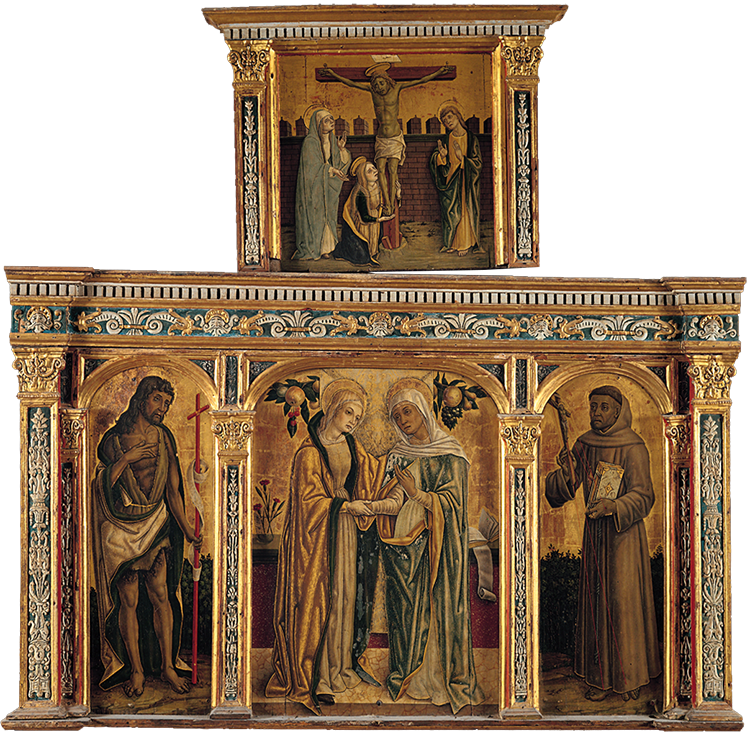
Triptych of the Visitation, Sant'Elpidio a Mare
The Civic Art Gallery of Sant'Elpidio a Mare houses a triptych by Vittore Crivelli, with the Visitation depicted in the center. The work was mentioned in the church of the Osservanti di Sant'Elpidio a Mare by Alessandro Maggiori in his 1832 inventory. Egidio Calzini saw the triptych in the Town Hall in 1901, next to the Coronation Polyptych, and attributed it to Carlo Crivelli. Later, Luigi Serra (1925) and Pietro Zampetti (1950) recognized Vittore's painting, and in 1972, Sandra di Provvido dated the triptych after the creation of the altarpiece in 1489 for Monte San Martino.
Alessandro Delpriori recently wrote about this work: “Vittore changes the way images are conceived, embracing a strongly classical culture, and declares his debt to Signorelli's idea in the frame of the Visitation polyptych now in the Pinacoteca in Sant'Elpidio a Mare, where the double column, proposed at the outer edges of the frame, creates the illusion of a loggia under which the scene is set.”
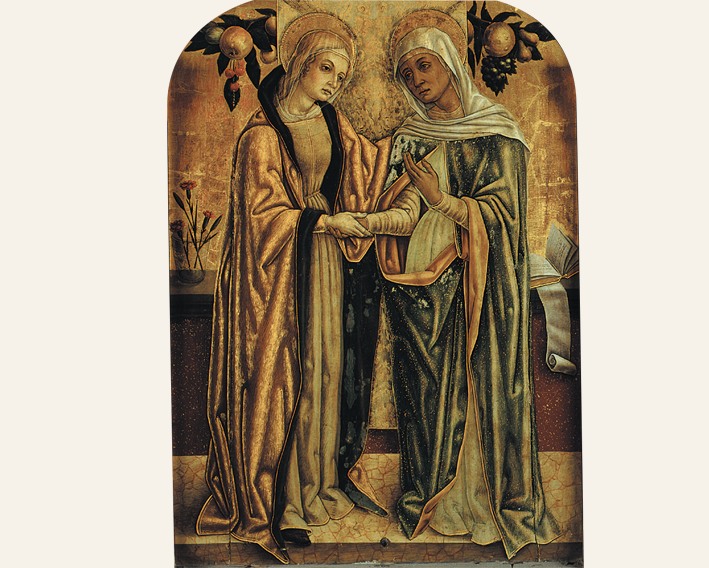
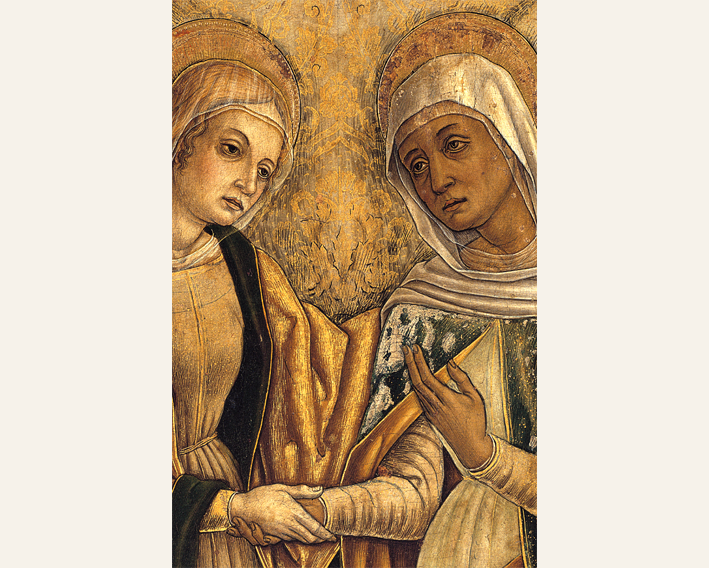
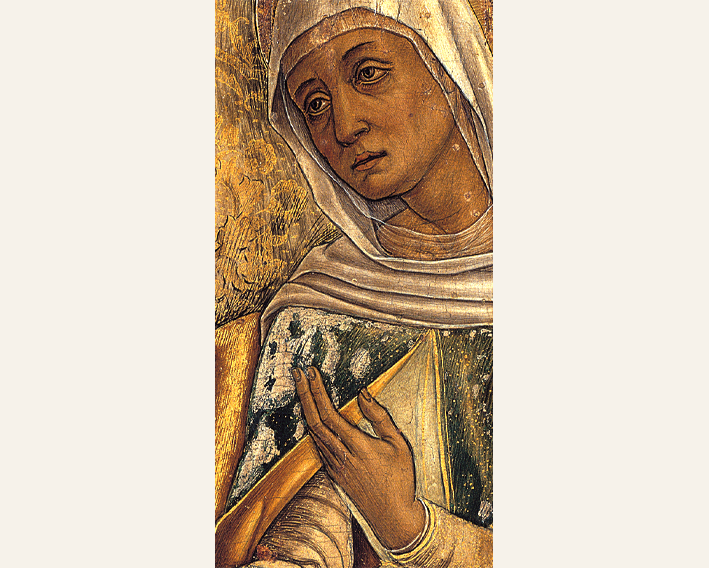
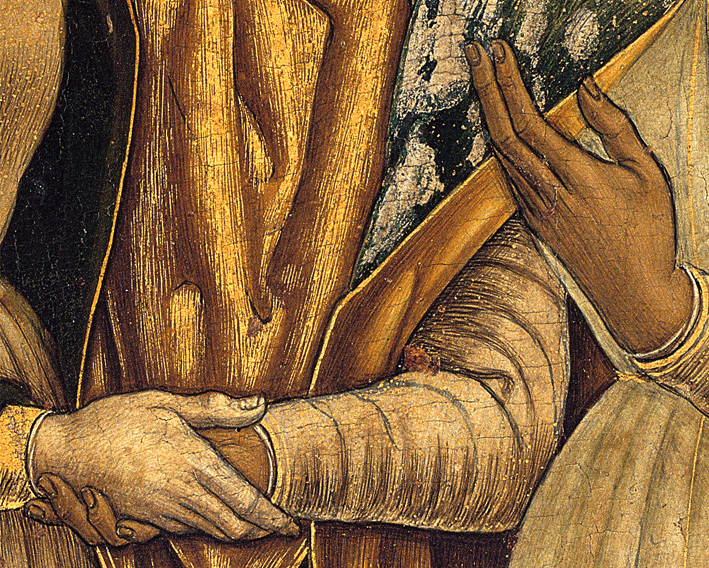
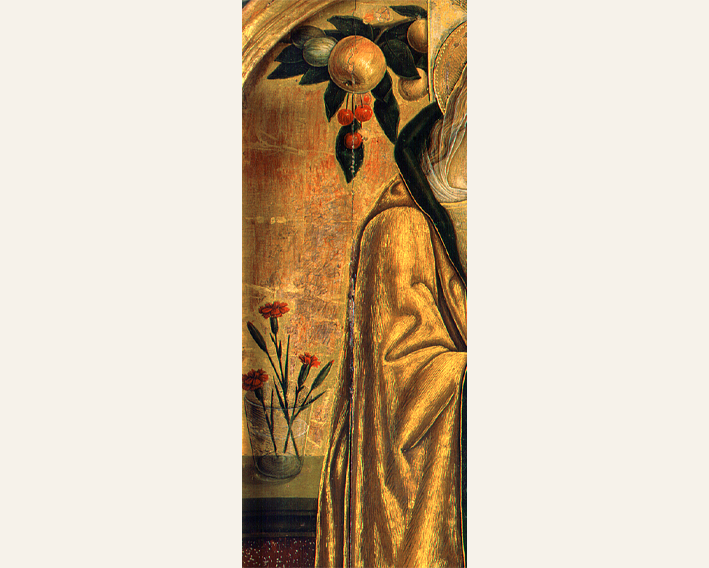
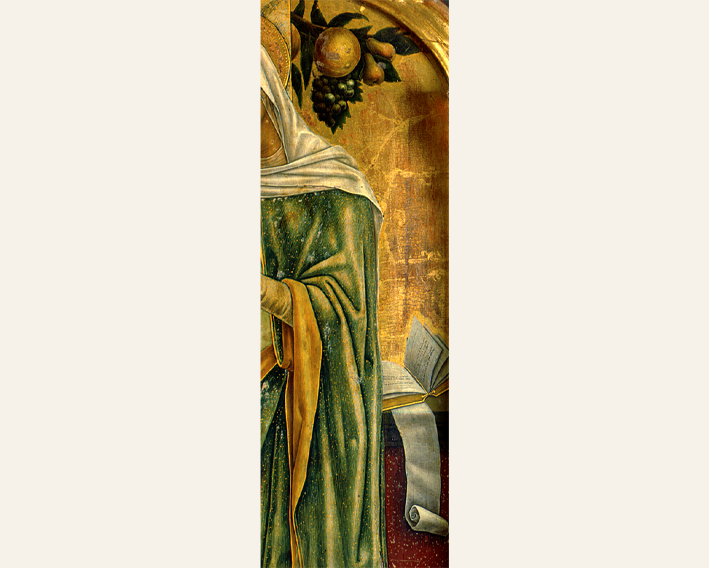
In fact, we are looking at a work that still has its original frame, consisting of gilded columns with white relief elements on a blue background. In the central panel, on the left, we see Mary, wrapped in a golden cloak, holding the hand of her cousin Elizabeth, who is pregnant with John the Baptist. Both women have golden halos on their heads, characterized by a series of punches and numerous radial incisions. The figures are depicted standing on a marble base, and behind them is a balustrade on which rests an open book and a transparent glass with three red carnations, symbolizing the blood of Christ.
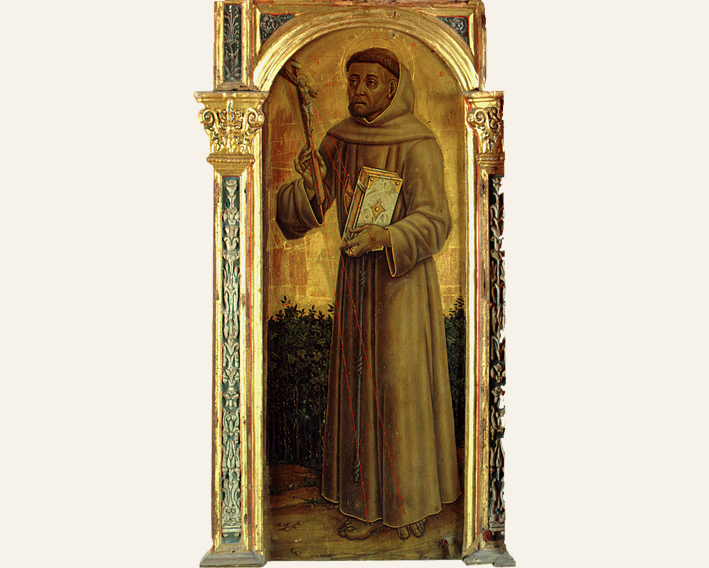
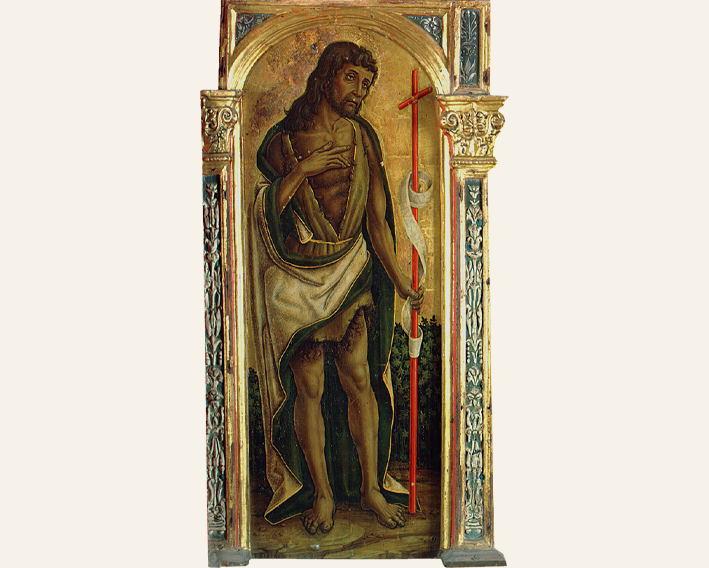
On the right panel is St. Francis receiving the stigmata from a crucifix he holds in his right hand, while on the opposite panel is St. John the Baptist in pilgrim's clothes with a staff wrapped in a scroll bearing the inscription: “ECCE AGNUS DEI.”
The triptych ends with a rectangular cymatium depicting a Crucifixion, which Giuseppe Capriotti hypothesizes is an early compositional experiment, as it was later reused and modified for the canvas created for the church of San Pietro located inside the medieval castle of Rocca Monte Varmine, in the current municipality of Carassai, but moved to the Municipal Art Gallery of Fermo.
The Civic Library of the same city houses a drawing of a Visitation, executed in pencil, pen, and brown ink on cream-colored paper. It was created by S. Mori and in the lower part of the representation, the following words can be read in Gothic script: FRANCISCUS GENTILIS DE FABRIANO. In 1889, Filippo Raffaelli saw a work and included it in the Artistic Guide to the City of Fermo, where the same scene as in the drawing was depicted in the center. This painting was in the Odescalchi collection in Bracciano in the last century and previously belonged to the De Minicis family of Fermo. In 2011, Francesca Coltrinari noted the dialogue between Mori's drawing, and therefore Francesco di Gentile's painting, and the central panel of Vittore Crivelli's triptych.
Vittore Crivelli
Trittico della Visitazione della Vergine
Tempera su tavola, 90×65 cm
Ordine inferiore
Visitazione della Vergine a S. Elisabetta, S. Giovanni Battista, S. Francesco
Pannello superiore
Crocifissione
Pinacoteca Civica – Palazzo ex Convento dei Filippini
Corso Baccio, 31
Sant’Elpidio a Mare (FM)
Triptych of the Visitation, Sant'Elpidio a Mare
The Civic Art Gallery of Sant'Elpidio a Mare houses a triptych by Vittore Crivelli, with the Visitation depicted in the center. The work was mentioned in the church of the Osservanti di Sant'Elpidio a Mare by Alessandro Maggiori in his 1832 inventory. Egidio Calzini saw the triptych in the Town Hall in 1901, next to the Coronation Polyptych, and attributed it to Carlo Crivelli. Later, Luigi Serra (1925) and Pietro Zampetti (1950) recognized Vittore's painting, and in 1972, Sandra di Provvido dated the triptych after the creation of the altarpiece in 1489 for Monte San Martino.
Alessandro Delpriori recently wrote about this work: “Vittore changes the way images are conceived, embracing a strongly classical culture, and declares his debt to Signorelli's idea in the frame of the Visitation polyptych now in the Pinacoteca in Sant'Elpidio a Mare, where the double column, proposed at the outer edges of the frame, creates the illusion of a loggia under which the scene is set.”
In fact, we are looking at a work that still has its original frame, consisting of gilded columns with white relief elements on a blue background. In the central panel, on the left, we see Mary, wrapped in a golden cloak, holding the hand of her cousin Elizabeth, who is pregnant with John the Baptist. Both women have golden halos on their heads, characterized by a series of punches and numerous radial incisions. The figures are depicted standing on a marble base, and behind them is a balustrade on which rests an open book and a transparent glass with three red carnations, symbolizing the blood of Christ.
On the right panel is St. Francis receiving the stigmata from a crucifix he holds in his right hand, while on the opposite panel is St. John the Baptist in pilgrim's clothes with a staff wrapped in a scroll bearing the inscription: “ECCE AGNUS DEI.”
The triptych ends with a rectangular cymatium depicting a Crucifixion, which Giuseppe Capriotti hypothesizes is an early compositional experiment, as it was later reused and modified for the canvas created for the church of San Pietro located inside the medieval castle of Rocca Monte Varmine, in the current municipality of Carassai, but moved to the Municipal Art Gallery of Fermo.
The Civic Library of the same city houses a drawing of a Visitation, executed in pencil, pen, and brown ink on cream-colored paper. It was created by S. Mori and in the lower part of the representation, the following words can be read in Gothic script: FRANCISCUS GENTILIS DE FABRIANO. In 1889, Filippo Raffaelli saw a work and included it in the Artistic Guide to the City of Fermo, where the same scene as in the drawing was depicted in the center. This painting was in the Odescalchi collection in Bracciano in the last century and previously belonged to the De Minicis family of Fermo. In 2011, Francesca Coltrinari noted the dialogue between Mori's drawing, and therefore Francesco di Gentile's painting, and the central panel of Vittore Crivelli's triptych.