Triptych of Cupra Marittima
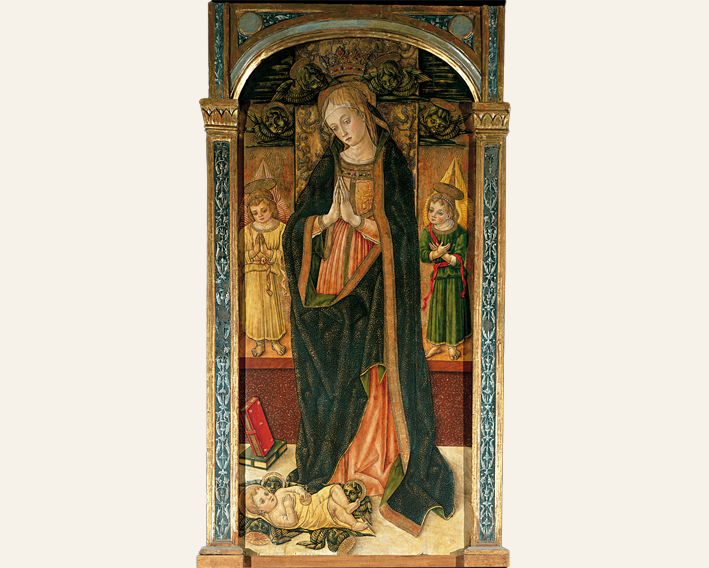
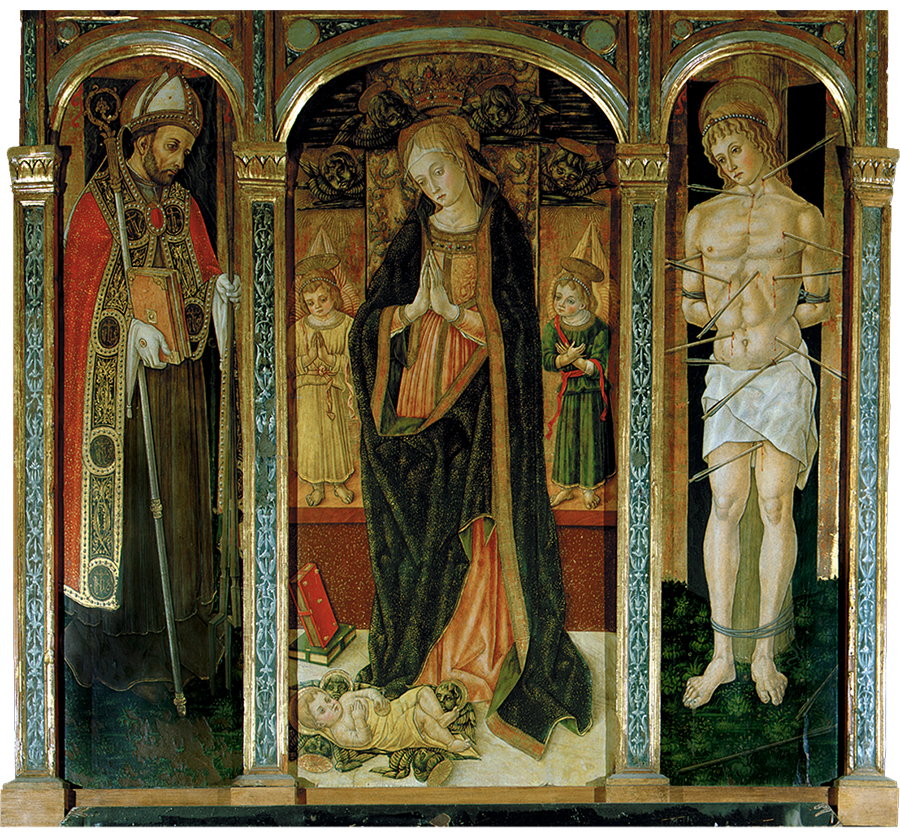
Today, on the high altar of the church of San Basso, we can see a beautiful triptych by Vittore Crivelli. It consists of three panels that are still joined by their original frame: in the center is a Madonna adoring the Child, while on the right panel is Saint Sebastian and on the opposite side is Saint Basso.
The triptych also consisted of a base and a cornice, where a Pietà or a Crucifixion was depicted, which were probably lost between the end of the 18th century and the beginning of the 19th century when the works were dismantled and placed on the antiques market.
The work underwent several moves: it was originally located in the Collegiate Church of Santa Maria in Castello di Marano, an ancient village above the current center of Cupra Marittima, but after the Valerio Decree of 1861, the panel was moved to the town hall, and it was not until 1887 that the current church of Santi Margherita e Basso was completed, which still houses the triptych hung in the apse behind the high altar.
The central panel depicts the Madonna standing, wrapped in a blue cloak edged and dotted with gold foil. The scene ends at the top with four cherubs, the uppermost of which are shown crowning the Woman, whose head is covered with a simple transparent veil.
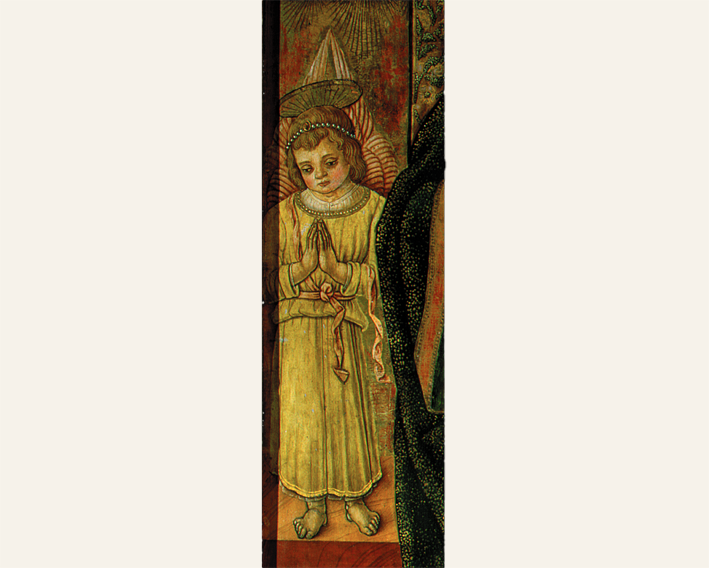
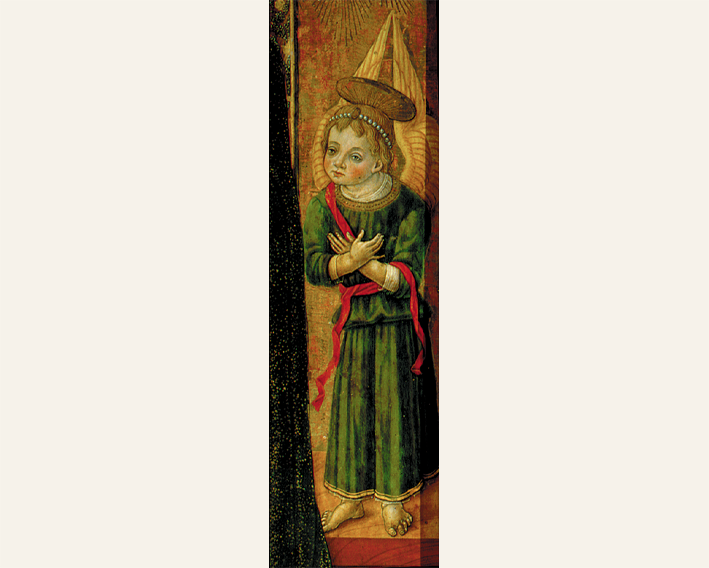
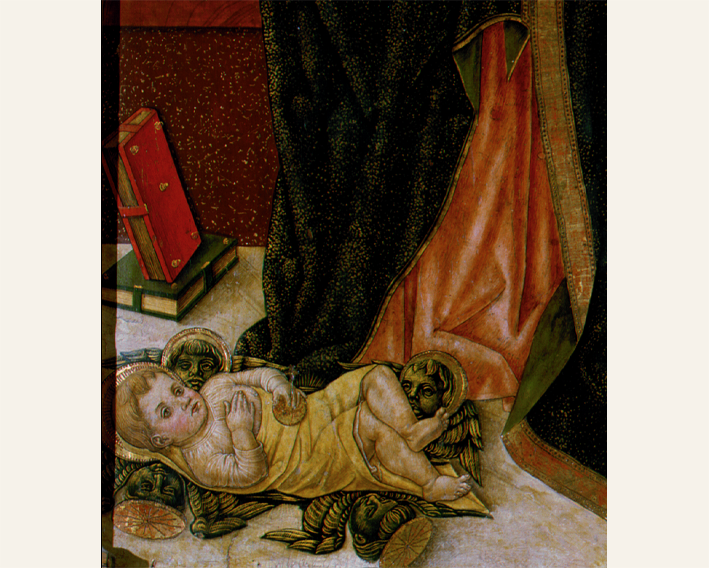
On either side of the Virgin are two angels standing on a balustrade made of pink marble and, on the front, red porphyry. They bow their heads, on which is placed a shortened halo, and turn their gaze to the Child. The latter is lying on a carpet of cherubs and holds a golden sphere with a granulated surface on one side.
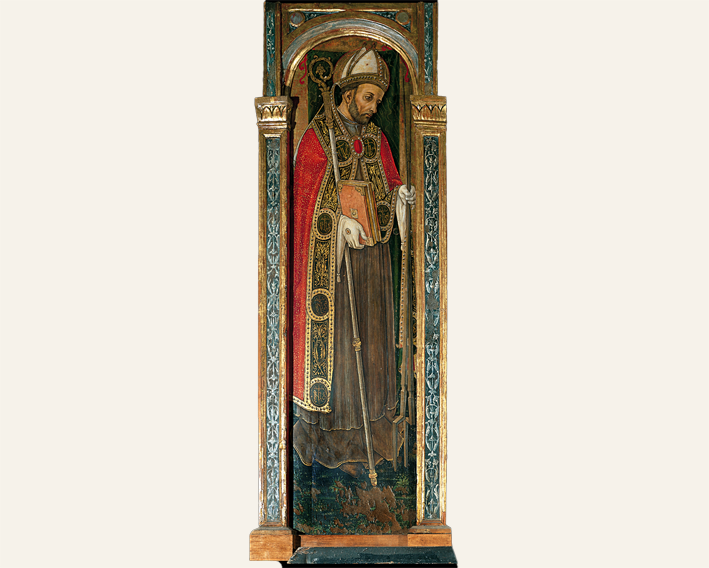
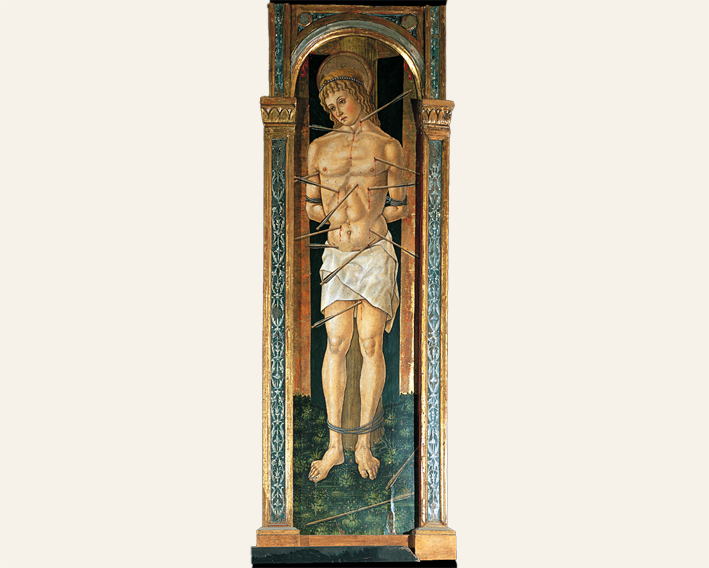
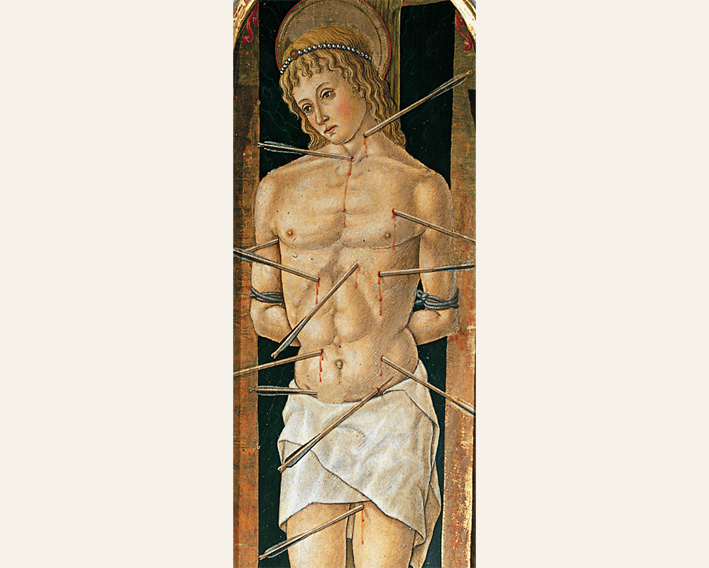
The right panel depicts Saint Sebastian pierced by numerous arrows, wearing a white cloth around his waist and adorned only with a crown of pearls, identical to those worn by the little angels in the central compartment. The martyred saint is tied with ropes to the trunk of a tree and rests his bare feet on a green meadow, the same one depicted in the opposite panel where a bishop is shown. In fact, the latter can be recognized as Saint Basso, patron saint of the city of Cupra Marittima, as he carries with him his symbols of martyrdom: two long nails that pierced him from the soles of his feet to his head.
Furthermore, the three panels are inserted in their original frame, richly decorated with gold and various pigments: the use of blue, probably azurite, stands out, on which white leaf motifs are drawn, made with white lead or white San Giovanni; while the arches and tondos are made with a light green.
The two saints and the Madonna are highlighted by drapes hanging behind them: behind the figures on the side panels are dark fabrics attached directly to the frame with laces, while the central panel is richly decorated with precious foil.
In his 2011 essay, Simone Settembri analyzes the back of the panels, indicating that Vittore Crivelli used “medium-quality wood that was roughly worked, as evidenced by the marks left by the gouges used for planing.” In addition, the marks of the old crossbars can still be seen, as well as “the minium red paint on the outer edge of the panels and, curiously, a sketch of a human figure, perhaps drawn by Vittore, a detail he shares with his brother, of whom there is a small drawing on the back of St. Francis (Musées des Beaux Arts, Brussels).”
Vittore Crivelli
Trittico
Madonna adorante il Bambino, S. Basso e S. Sebastiano, 1494
Tempera su tavola, 177×166 cm
Chiesa Parrocchiale di S. Basso e Santa Margherita
Via Camillo Benso Conte di Cavour, 23
Cupra Marittima (AP)
Triptych of Cupra Marittima
Today, on the high altar of the church of San Basso, we can see a beautiful triptych by Vittore Crivelli. It consists of three panels that are still joined by their original frame: in the center is a Madonna adoring the Child, while on the right panel is Saint Sebastian and on the opposite side is Saint Basso.
The triptych also consisted of a base and a cornice, where a Pietà or a Crucifixion was depicted, which were probably lost between the end of the 18th century and the beginning of the 19th century when the works were dismantled and placed on the antiques market.
The work underwent several moves: it was originally located in the Collegiate Church of Santa Maria in Castello di Marano, an ancient village above the current center of Cupra Marittima, but after the Valerio Decree of 1861, the panel was moved to the town hall, and it was not until 1887 that the current church of Santi Margherita e Basso was completed, which still houses the triptych hung in the apse behind the high altar.
The central panel depicts the Madonna standing, wrapped in a blue cloak edged and dotted with gold foil. The scene ends at the top with four cherubs, the uppermost of which are shown crowning the Woman, whose head is covered with a simple transparent veil.
On either side of the Virgin are two angels standing on a balustrade made of pink marble and, on the front, red porphyry. They bow their heads, on which is placed a shortened halo, and turn their gaze to the Child. The latter is lying on a carpet of cherubs and holds a golden sphere with a granulated surface on one side.
The right panel depicts Saint Sebastian pierced by numerous arrows, wearing a white cloth around his waist and adorned only with a crown of pearls, identical to those worn by the little angels in the central compartment. The martyred saint is tied with ropes to the trunk of a tree and rests his bare feet on a green meadow, the same one depicted in the opposite panel where a bishop is shown. In fact, the latter can be recognized as Saint Basso, patron saint of the city of Cupra Marittima, as he carries with him his symbols of martyrdom: two long nails that pierced him from the soles of his feet to his head.
Furthermore, the three panels are inserted in their original frame, richly decorated with gold and various pigments: the use of blue, probably azurite, stands out, on which white leaf motifs are drawn, made with white lead or white San Giovanni; while the arches and tondos are made with a light green.
The two saints and the Madonna are highlighted by drapes hanging behind them: behind the figures on the side panels are dark fabrics attached directly to the frame with laces, while the central panel is richly decorated with precious foil.
In his 2011 essay, Simone Settembri analyzes the back of the panels, indicating that Vittore Crivelli used “medium-quality wood that was roughly worked, as evidenced by the marks left by the gouges used for planing.” In addition, the marks of the old crossbars can still be seen, as well as “the minium red paint on the outer edge of the panels and, curiously, a sketch of a human figure, perhaps drawn by Vittore, a detail he shares with his brother, of whom there is a small drawing on the back of St. Francis (Musées des Beaux Arts, Brussels).”