Pietà, Fermo
The panel was part of a polyptych that was dismantled, and some of the panels were probably sold in the 19th century. It was commissioned for the church of San Giuliano in Fermo by Prior Don Piersante di Antonuccio and the mayors of the building, Evangelista di ser Lucentino and Nicolò di Giovanni Menici da Fermo, on November 9, 1487.
The polyptych consisted of five compartments, with the Madonna and Child, now preserved in the same museum, in the center. The work was paid for with 70 ducats and was to be the model for the triptych for the church of Carità in Fermo.
The Pietà was identified as a “work of the 15th-century Venetian school” by Arduino Colasanti (1907) and subsequently attributed to Vittore by Tancred Borenius in 1912, a theory also accepted by Laudedeo Testi and Luigi Serra. Pietro Zampetti, in the 1950 exhibition in Ancona, hypothesized that the two panels from Fermo were part of a single polyptych.
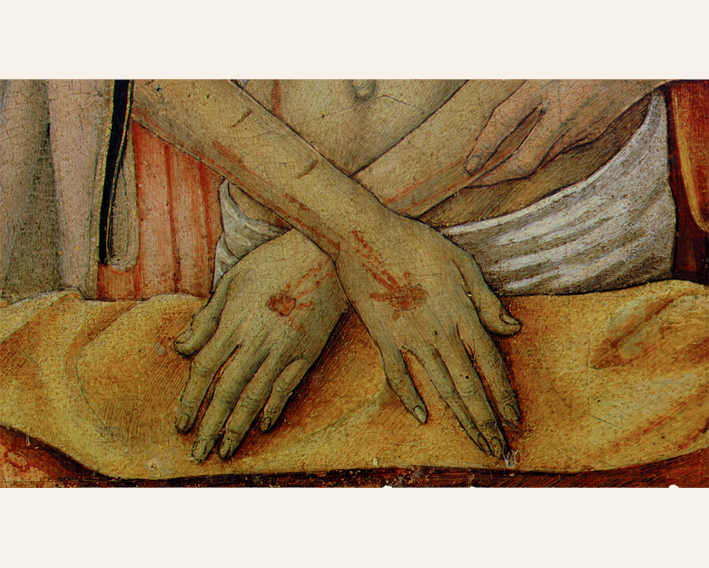
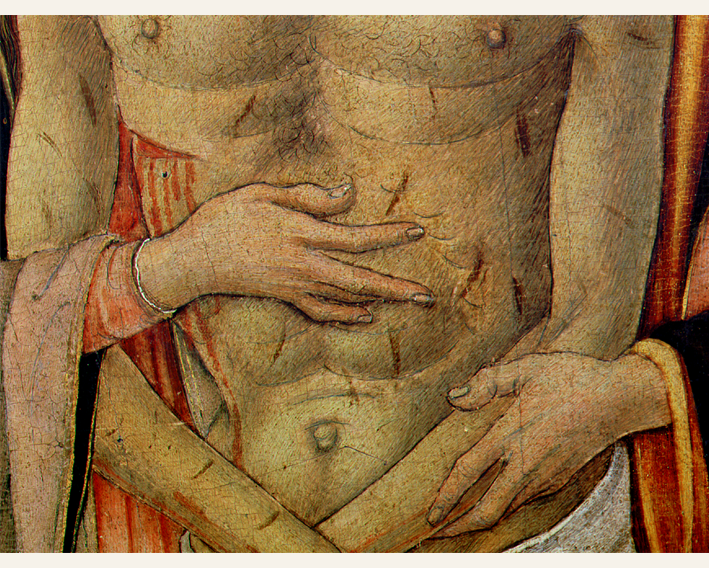
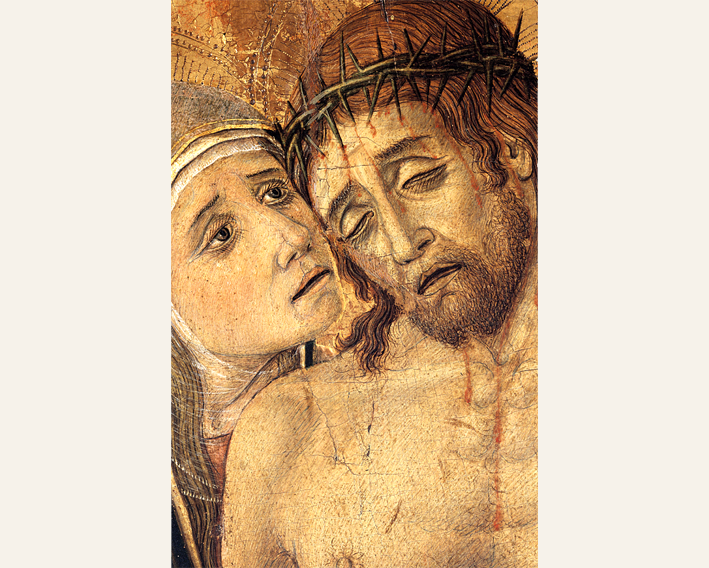
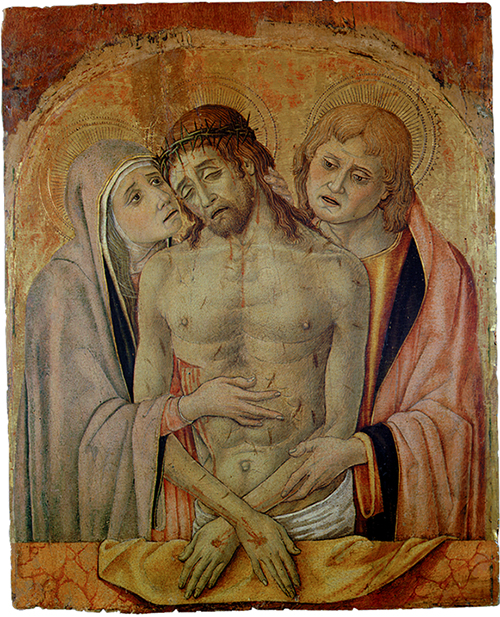
Federico Zeri compared the painting to the small Pietà in Urbino, one of the very first works painted by Vittore in the Marche region. The similarities and analogies with the drawing of the Madonna and Child are evident in the protuberances of the bones and the long, nervous fingers, the elongated S of the sinuous lines of the hair, and the sharp angles of the lines of the faces in both paintings. The scene depicted by Vittore Crivelli is set behind a marble balustrade on which a yellow sheet is draped, where the Dead Christ delicately rests his two wounded hands.
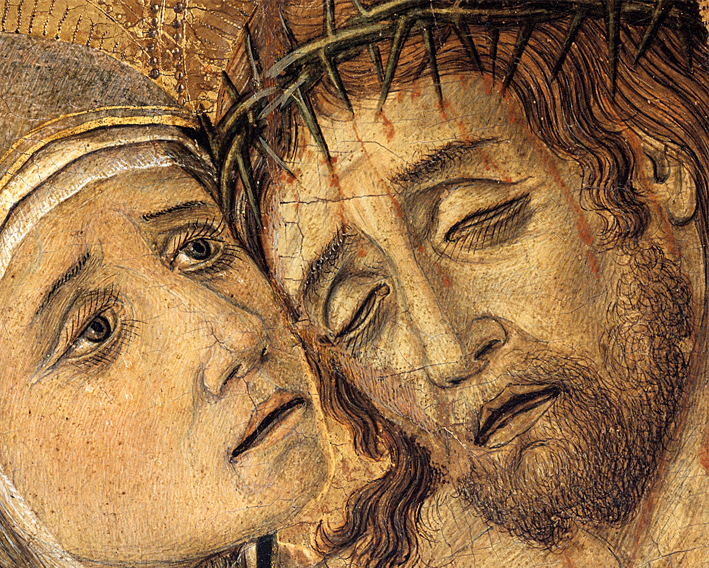
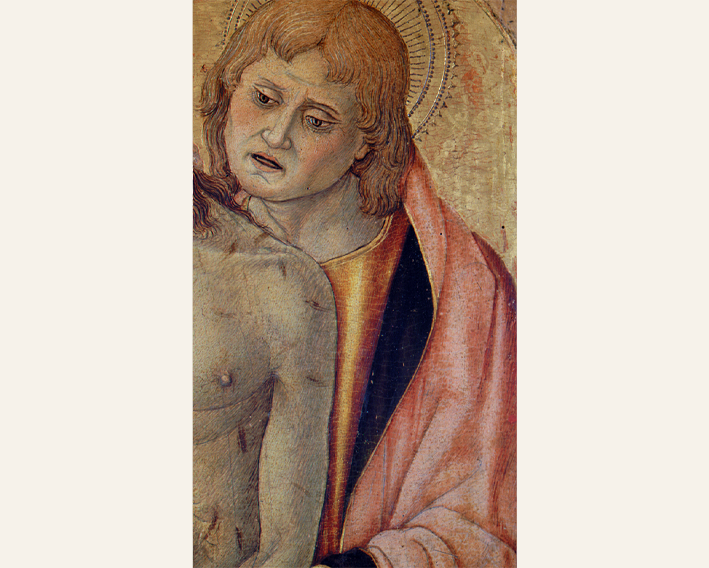
On either side of Jesus are the Virgin Mary and St. John the Evangelist, who embrace each other in anguish.
The background of the work is created using the technique of gilding with gouache, where in some places the Armenian bole has re-emerged.
The halos are created by engraving directly onto the gold and then punching it.
Vittore Crivelli
Pietà, 1487 ca
Tempera su tavola, 77×61 cm
Museo Diocesano
Piazzale Girfalco
Fermo (FM)
Pietà, Fermo
The panel was part of a polyptych that was dismantled, and some of the panels were probably sold in the 19th century. It was commissioned for the church of San Giuliano in Fermo by Prior Don Piersante di Antonuccio and the mayors of the building, Evangelista di ser Lucentino and Nicolò di Giovanni Menici da Fermo, on November 9, 1487.
The polyptych consisted of five compartments, with the Madonna and Child, now preserved in the same museum, in the center. The work was paid for with 70 ducats and was to be the model for the triptych for the church of Carità in Fermo.
The Pietà was identified as a “work of the 15th-century Venetian school” by Arduino Colasanti (1907) and subsequently attributed to Vittore by Tancred Borenius in 1912, a theory also accepted by Laudedeo Testi and Luigi Serra. Pietro Zampetti, in the 1950 exhibition in Ancona, hypothesized that the two panels from Fermo were part of a single polyptych.
Federico Zeri compared the painting to the small Pietà in Urbino, one of the very first works painted by Vittore in the Marche region. The similarities and analogies with the drawing of the Madonna and Child are evident in the protuberances of the bones and the long, nervous fingers, the elongated S of the sinuous lines of the hair, and the sharp angles of the lines of the faces in both paintings. The scene depicted by Vittore Crivelli is set behind a marble balustrade on which a yellow sheet is draped, where the Dead Christ delicately rests his two wounded hands.
On either side of Jesus are the Virgin Mary and St. John the Evangelist, who embrace each other in anguish.
The background of the work is created using the technique of gilding with gouache, where in some places the Armenian bole has re-emerged.
The halos are created by engraving directly onto the gold and then punching it.