Madonna della Cintola, Massa Fermana
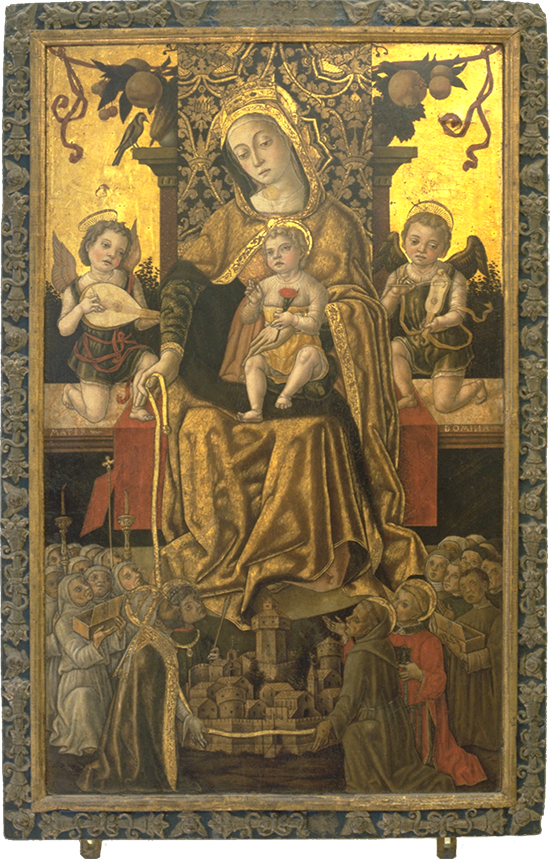
Vittore Crivelli created a painting for the people of Massa Fermana, a Madonna della Cintola measuring 125 × 80 cm, dating from between 1490 and 1495.
This scene had already been painted by Lorenzo d'Alessandro in 1491, a work that is now preserved in the Museo dell'Arte Recuperata in San Severino Marche, following the 2016 earthquake. This panel was commissioned by the Observant Franciscan Francesco Piani di Caldarola and bears the inscription “SVB ANNO DOMINI M CCCC LXXXXI LAVRETIVS S PISIT” at the bottom.
Vittore's panel is unsigned, but the only inscriptions are found on either side of the Virgin, “MATER DOMINA,” while along the waistband we read “MATER DOMINA PAX ET VITA OMNIUM HIC CI(NC)TOR(UM) SUM EGO MARIA.”
The work was attributed to Vittore Crivelli only in 1997 by Sandra di Provvido.
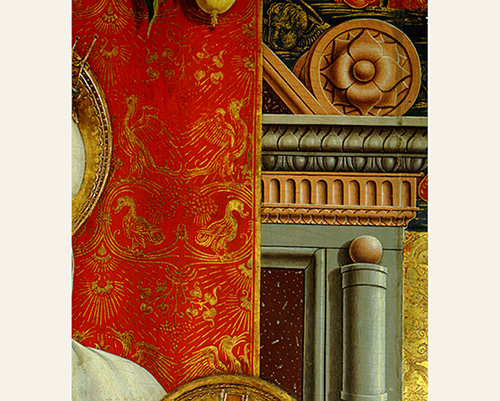
In the center of the panel is the Madonna, seated on a throne, gently holding the Child on her lap. The Virgin wears a beautiful yellow cloak with gold detailing to simulate the softness of the fabric, which is edged with a floral motif, also in gold.
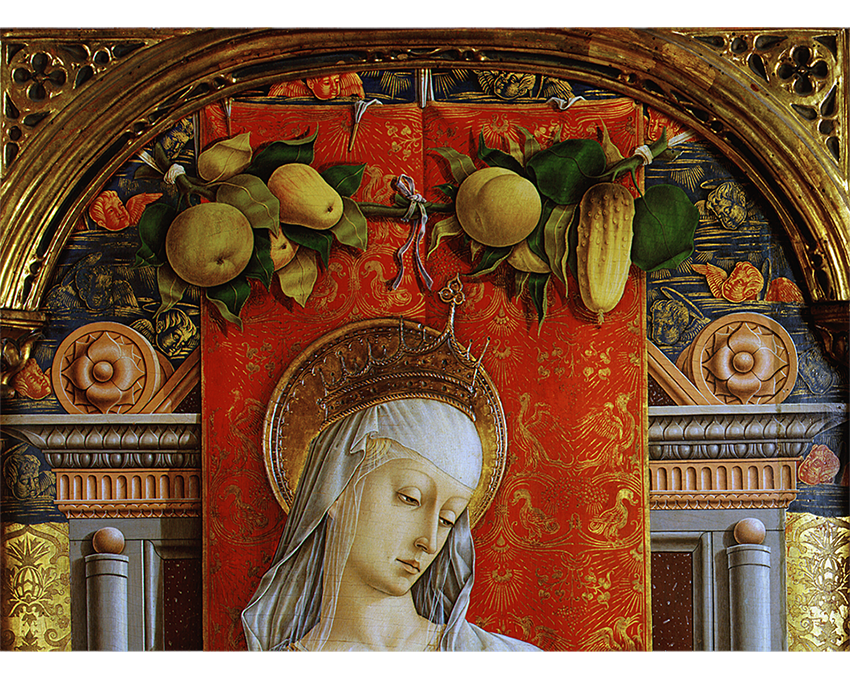
The woman's head is covered by the fabric described above, and underneath is a refined transparent veil that reveals her wavy hair. Underneath the cloak, she wears a red robe with blue sleeves richly decorated with gold dots inserted using the shell technique. On her head is a crown made entirely of gold with painted stones and a disc-shaped halo.
The Baby Jesus is depicted blessing his mother's actions and holding a red carnation, symbol of spousal love, in his other hand. The blond, curly-haired Child wears the same clothes created by his brother Carlo in the 1468 polyptych, also for Massa Fermana.
In her other hand, the Virgin holds a yellow belt with a golden inscription. It reaches down and encircles the city, which is protected by four saints accompanied by their attributes: Sebastian is dressed but holds an arrow in his hand; Bishop Sylvester; Francis dressed in a habit showing his stigmata; and finally, Lawrence carrying a gridiron.
On the left, there is a group of devotees, probably belonging to the confraternity that commissioned the painting. On the opposite side, the people, both men and women, are depicted looking towards the Madonna and asking for salvation.
The leaders of the groups carry an open chest containing keys and gold coins, which will be donated to the Virgin as a symbol of immense devotion and gratitude.
The scene was analyzed by Giuseppe Capriotti in 2011, during the exhibition on Vittore Crivelli, where he also examined Lorenzo d'Alessandro's Caldarola panel. The work of the Sanseverino artist differs from that of the Venetian in that the Madonna gathers the important things of the community around her with her belt. These are placed on two panels, which are supported by various saints.
A crucial element for dating Vittore Crivelli's panel is the bird perched on the throne's sill: it is a robin that was first painted by Carlo Crivelli in the Ottoni Altarpiece for the church of San Francesco in Matelica, now preserved in the National Gallery in London. This panel was commissioned in 1491 and paid for in 1494 by Ranuccio Ottoni, who wanted it for his family chapel in the church, and can probably be taken as a post quem for the panel in Massa Fermana.
Furthermore, the work was observed very carefully by Giuseppe Capriotti in 2011, who reports that: “From a technical point of view, the panel has lobed incisions in the lower part of the painting, which are generally used by Vittore to delimit the shape of the polyptych. This material evidence documents that the panel was previously intended for another use and was later reused. The same incisions, used as a preparatory drawing, are also visible in the figure of the goldfinch.”
Finally, Simone Settembri, in his 2011 essay, published photos of the back of the panel, where it can be seen that it is composed of a central panel 112 cm wide, to which two side strips, each 6 cm wide, are attached.
Vittore Crivelli
Madonna col Bambino santi e donatori, 1490 – 1495 ca.
Tempera su tavola, 125×80 cm
Pinacoteca Comunale (già Parrocchiale dei SS. Lorenzo, Silvestro e Ruffino)
Via Giuseppe Garibaldi, 60
Massa Fermana (FM)
Madonna della Cintola, Massa Fermana
Vittore Crivelli created a painting for the people of Massa Fermana, a Madonna della Cintola measuring 125 × 80 cm, dating from between 1490 and 1495.
This scene had already been painted by Lorenzo d'Alessandro in 1491, a work that is now preserved in the Museo dell'Arte Recuperata in San Severino Marche, following the 2016 earthquake. This panel was commissioned by the Observant Franciscan Francesco Piani di Caldarola and bears the inscription “SVB ANNO DOMINI M CCCC LXXXXI LAVRETIVS S PISIT” at the bottom.
Vittore's panel is unsigned, but the only inscriptions are found on either side of the Virgin, “MATER DOMINA,” while along the waistband we read “MATER DOMINA PAX ET VITA OMNIUM HIC CI(NC)TOR(UM) SUM EGO MARIA.”
The work was attributed to Vittore Crivelli only in 1997 by Sandra di Provvido.
In the center of the panel is the Madonna, seated on a throne, gently holding the Child on her lap. The Virgin wears a beautiful yellow cloak with gold detailing to simulate the softness of the fabric, which is edged with a floral motif, also in gold.
The woman's head is covered by the fabric described above, and underneath is a refined transparent veil that reveals her wavy hair. Underneath the cloak, she wears a red robe with blue sleeves richly decorated with gold dots inserted using the shell technique. On her head is a crown made entirely of gold with painted stones and a disc-shaped halo.
The Baby Jesus is depicted blessing his mother's actions and holding a red carnation, symbol of spousal love, in his other hand. The blond, curly-haired Child wears the same clothes created by his brother Carlo in the 1468 polyptych, also for Massa Fermana.
In her other hand, the Virgin holds a yellow belt with a golden inscription. It reaches down and encircles the city, which is protected by four saints accompanied by their attributes: Sebastian is dressed but holds an arrow in his hand; Bishop Sylvester; Francis dressed in a habit showing his stigmata; and finally, Lawrence carrying a gridiron.
On the left, there is a group of devotees, probably belonging to the confraternity that commissioned the painting. On the opposite side, the people, both men and women, are depicted looking towards the Madonna and asking for salvation.
The leaders of the groups carry an open chest containing keys and gold coins, which will be donated to the Virgin as a symbol of immense devotion and gratitude.
The scene was analyzed by Giuseppe Capriotti in 2011, during the exhibition on Vittore Crivelli, where he also examined Lorenzo d'Alessandro's Caldarola panel. The work of the Sanseverino artist differs from that of the Venetian in that the Madonna gathers the important things of the community around her with her belt. These are placed on two panels, which are supported by various saints.
A crucial element for dating Vittore Crivelli's panel is the bird perched on the throne's sill: it is a robin that was first painted by Carlo Crivelli in the Ottoni Altarpiece for the church of San Francesco in Matelica, now preserved in the National Gallery in London. This panel was commissioned in 1491 and paid for in 1494 by Ranuccio Ottoni, who wanted it for his family chapel in the church, and can probably be taken as a post quem for the panel in Massa Fermana.
Furthermore, the work was observed very carefully by Giuseppe Capriotti in 2011, who reports that: “From a technical point of view, the panel has lobed incisions in the lower part of the painting, which are generally used by Vittore to delimit the shape of the polyptych. This material evidence documents that the panel was previously intended for another use and was later reused. The same incisions, used as a preparatory drawing, are also visible in the figure of the goldfinch.”
Finally, Simone Settembri, in his 2011 essay, published photos of the back of the panel, where it can be seen that it is composed of a central panel 112 cm wide, to which two side strips, each 6 cm wide, are attached.