Madonna Adoring the Child, Sarnano
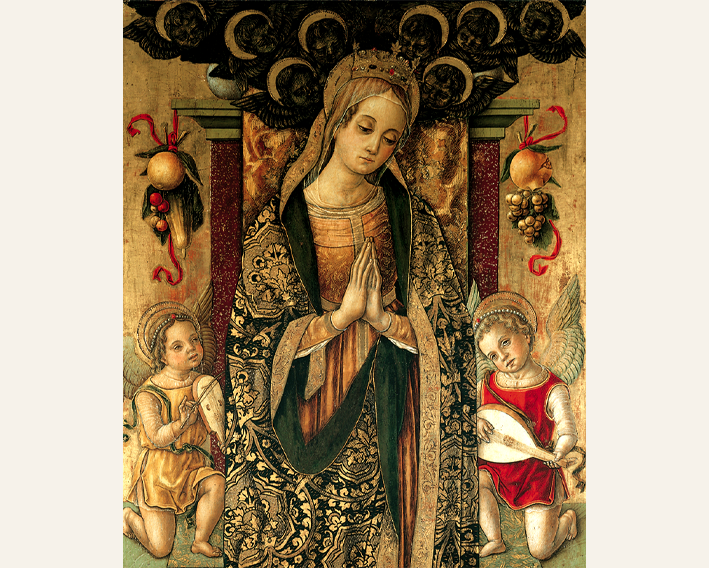
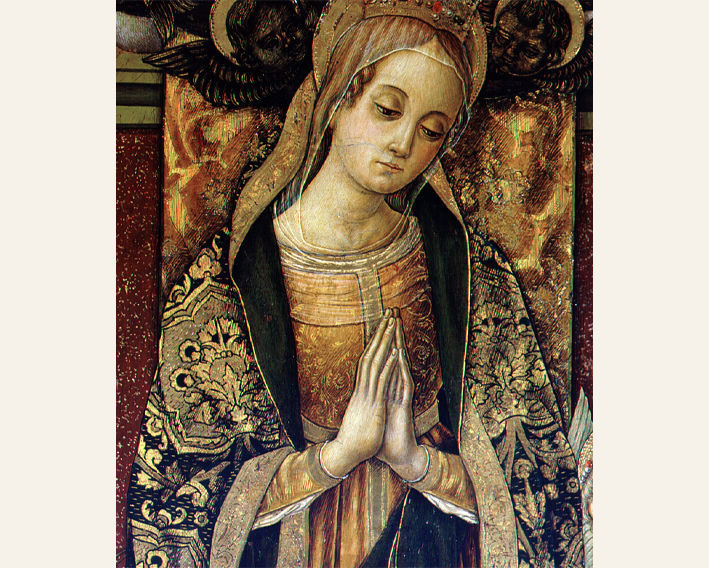
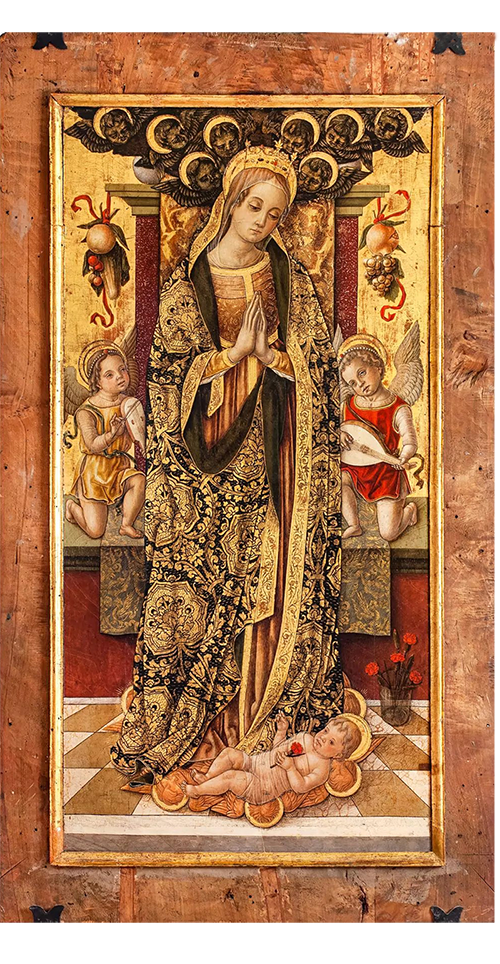
Vittore Crivelli painted Madonna Adoring the Child for the church of San Francesco in Sarnano in the early 1490s. It was placed on the third altar on the left of the church of San Francesco and is described in the notes of Sir Charles Easlake, the first director of the National Gallery in London, during his trip to Italy in 1858. The scholar doubts Vittore's authorship and reports the poor state of preservation, partly blackened and damaged due to a horizontal fracture that crossed the Virgin's face, from under her right eye to her upper lip. In 1922, Luigi Serra judged the painting to be one of the most delicate and rich of all the works created by the Venetian artist.
It is a painting in its own right, executed on a thick panel with a large space around it where the frame was housed, perhaps made of pastiglia, as suggested by Deborah Maria Piccinini, as in the Madonna della Cintola of Massa Fermana from the early 1490s.
By comparing the panel from Falerone with that from Sarnano, we can see how Vittore Crivelli's style changed over the course of a decade, as the figures in the earlier work seem to be flattened on the surface, while those in the later work are set further back and manage to fill the background of the painting. This detail was noted by Alessandro Delpriori (2011), who pointed out that Vittore wanted to respond to some new stimulus, which probably came to him from the sacristy of San Giovanni a Loreto, designed by Luca Signorelli.
At the center of the panel is a beautiful standing Madonna wrapped in a rich blue and gold cloak with thistle flower motifs. The woman's head is covered by a transparent veil that reveals her hair, and she wears a crown studded with precious stones. The Virgin does not rest her feet on the marble floor, but on a cloud of red angels, called seraphim, who also support the Baby Jesus.
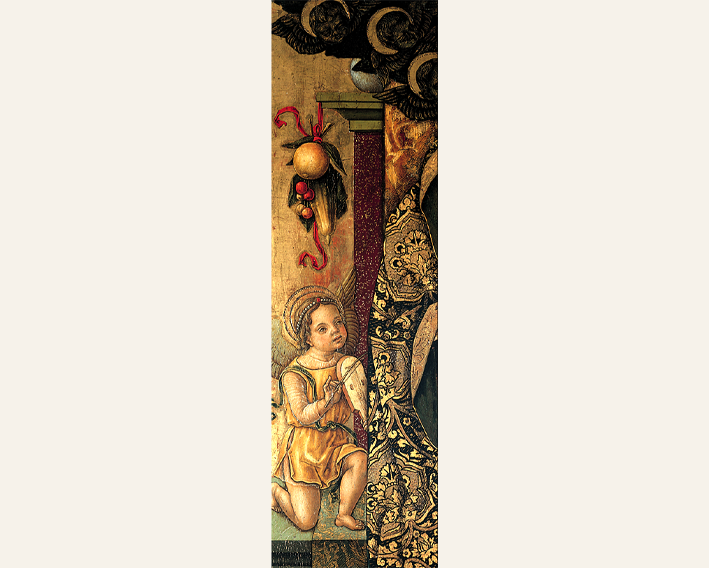
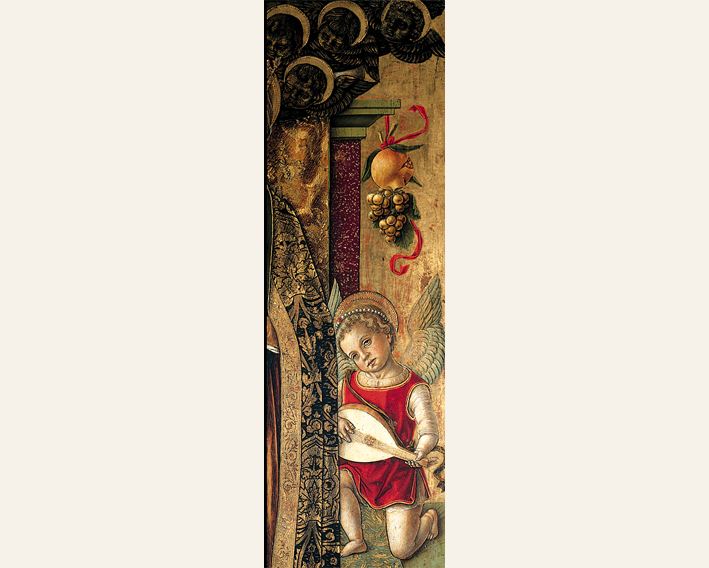
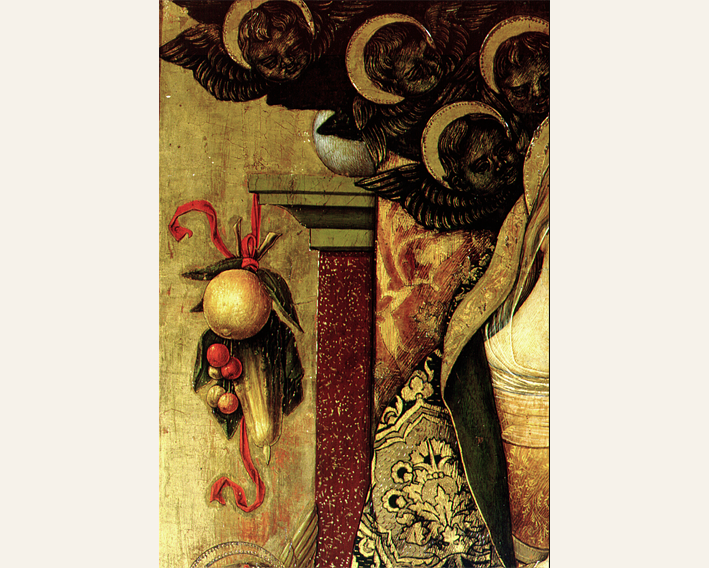
Behind the figure is a throne made of different minerals, simulated by the painter through the use of various pigments. The garlands hanging from the throne depict various fruits and vegetables: the cucumber alludes to the rebirth of Jonah and, therefore, to the Resurrection; the apple is linked to original sin; the cherries represent the blood of Christ; while the grapes are divided into vines (Christ) and branches (the people of God), and then become a Eucharistic symbol; finally, the pomegranate refers to the blood of Jesus.
On either side of the Madonna are two kneeling cherubs playing music, one playing the lyre, which symbolizes poetry, while the other plays the lute, which refers to instrumental music.
Finally, the Baby Jesus looks at his Mother and blesses her with his right hand, while in his other hand he holds a red carnation, which is a symbol referring to the Virgin Mary.
Vittore Crivelli
Madonna adorante il Bambino tra due angeli musicanti
Tempera su tavola, 160×83 cm
Pinacoteca Comunale e Musei Civici
Via Giacomo Leopardi snc
Sarnano (MC)
Madonna Adoring the Child, Sarnano
Vittore Crivelli painted Madonna Adoring the Child for the church of San Francesco in Sarnano in the early 1490s. It was placed on the third altar on the left of the church of San Francesco and is described in the notes of Sir Charles Easlake, the first director of the National Gallery in London, during his trip to Italy in 1858. The scholar doubts Vittore's authorship and reports the poor state of preservation, partly blackened and damaged due to a horizontal fracture that crossed the Virgin's face, from under her right eye to her upper lip. In 1922, Luigi Serra judged the painting to be one of the most delicate and rich of all the works created by the Venetian artist.
It is a painting in its own right, executed on a thick panel with a large space around it where the frame was housed, perhaps made of pastiglia, as suggested by Deborah Maria Piccinini, as in the Madonna della Cintola of Massa Fermana from the early 1490s.
By comparing the panel from Falerone with that from Sarnano, we can see how Vittore Crivelli's style changed over the course of a decade, as the figures in the earlier work seem to be flattened on the surface, while those in the later work are set further back and manage to fill the background of the painting. This detail was noted by Alessandro Delpriori (2011), who pointed out that Vittore wanted to respond to some new stimulus, which probably came to him from the sacristy of San Giovanni a Loreto, designed by Luca Signorelli.
At the center of the panel is a beautiful standing Madonna wrapped in a rich blue and gold cloak with thistle flower motifs. The woman's head is covered by a transparent veil that reveals her hair, and she wears a crown studded with precious stones. The Virgin does not rest her feet on the marble floor, but on a cloud of red angels, called seraphim, who also support the Baby Jesus.
Behind the figure is a throne made of different minerals, simulated by the painter through the use of various pigments. The garlands hanging from the throne depict various fruits and vegetables: the cucumber alludes to the rebirth of Jonah and, therefore, to the Resurrection; the apple is linked to original sin; the cherries represent the blood of Christ; while the grapes are divided into vines (Christ) and branches (the people of God), and then become a Eucharistic symbol; finally, the pomegranate refers to the blood of Jesus.
On either side of the Madonna are two kneeling cherubs playing music, one playing the lyre, which symbolizes poetry, while the other plays the lute, which refers to instrumental music.
Finally, the Baby Jesus looks at his Mother and blesses her with his right hand, while in his other hand he holds a red carnation, which is a symbol referring to the Virgin Mary.