
I CRIVELLI
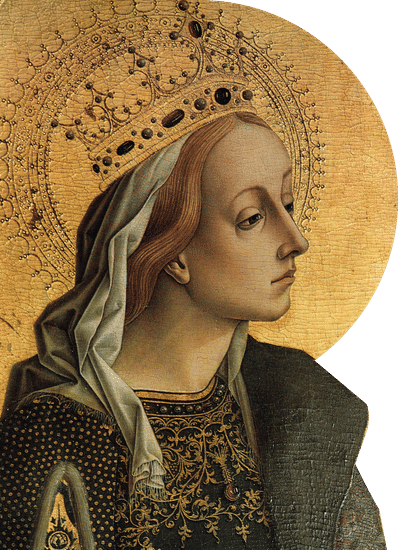
Carlo Crivelli
Carlo Crivelli was born in Venice in about 1430, but left the lagoon city as a young man, never to return, probably because of a young love that ended with a trial and a period spent in prison.
He worked in Padua, in the Squarcione workshop, at the time when Mantegna was also collaborating there, whose influence, together with that of Filippo Lippi and Donatello, can be found in his first works, such as in the Veronese Madonna della Passione (Castelvecchio Museum), where the Venetian late-Gothic Renaissance modes are associated with a strong tendency towards formal, tense and refined abstraction, made even more intense by the glazed colors that evoke the brilliance of Byzantine icons and mosaics.
Subsequently, the painter left Padua in the wake of Schiavone, to reach Zara, a city where he is attested in 1465 as a citizen, to arrive immediately afterwards in the Marche, where in 1468 he signed and dated the polyptych of Massa Fermana, which was followed, in 1470, by the polyptych of Porto San Giorgio, dismembered at the beginning of the nineteenth century and dispersed in various museums.
This is not an isolated case: born in the Marche region, between Fermo, Camerino, Fabriano, Ascoli Piceno, many of his works placed in churches and districts often unreachable in past centuries, began to disperse first due to the Napoleonic spoliations, which contributed to bringing many of his panels to Brera, and later following the great appreciation that the Anglo-Saxon world reserved for the art of the ‘primitives’ of the fifteenth century (until recently an entire The room of the National Gallery in London was dedicated exclusively to the paintings of Carlo Crivelli).
Already settled in 1469 in Ascoli Piceno, the artist created the polyptych for the city’s cathedral in 1473, which has come down to us intact with its precious frame, a work characterized by an unprecedented and crystalline preciousness and an enameled chromatic substance, the result of a very personal stylistic code that will meet great fortune among his epigones. Here, then, are his baskets of fruit, evident, palpable and at the same time detached from reality, fixed in their purely aesthetic dimension, or the characters of the polyptychs, including the superb saints Magdalene and Catherine, solemn in the elegant brocades, in the cloaks of heavy vermilion red velvet, with incredible hairstyles elaborated among strands of precious pearls. Crivelli excelled in expressing gestures of pain and in depicting admirable intertwining of hands, images that stand out in the icy silence of the enameled colors on the table, thanks to a chromatic substance that holds the object, blocks it on the surface, as in a Byzantine icon.
In Ascoli the painter continued to have a home and family, but he was also active in the Fermo area, in Camerino, Ancona, Fabriano, Matelica. He died before 3 September 1495, the date on which his brother Vittore claimed his inheritance.
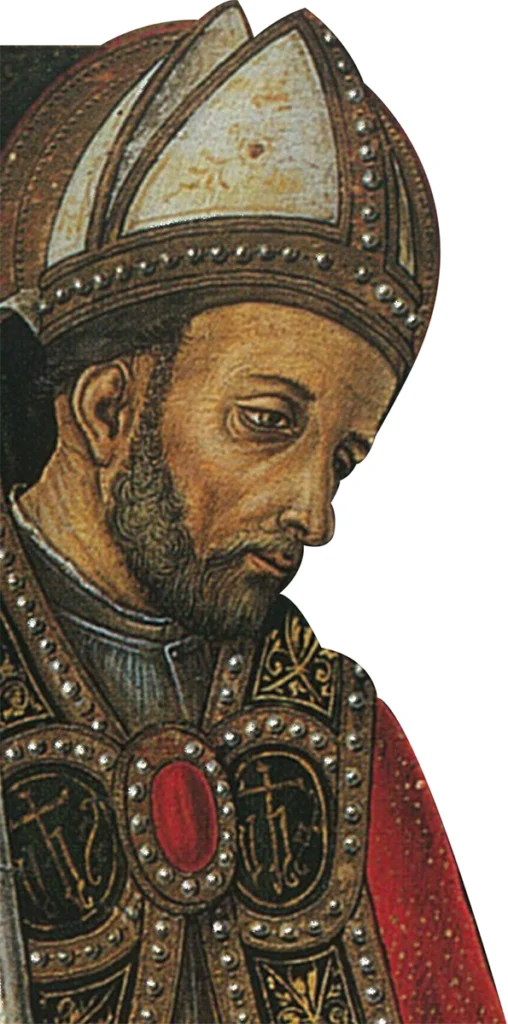
Vittore Crivelli
Brother of Carlo, he was born in Venice around 1440 and died in Fermo between 1501 and 1502. In 1481 he is documented in the Marche, in Montelparo, engaged in a painting for the church of the Madonna di Loreto. Before settling in Fermo, in the Marche region, he was active in Dalmatia, in Zara, between 1469 and 1476. It was probably Carlo who called him, in order to help him in the numerous commissions obtained in the Marche. Vittore worked in the Fermo area, Carlo in the Ascolano area: it seems that the two brothers had divided the area of influence over the two cities of the southern Marche, which were often fighting each other.
Although his production was based on that of his more gifted brother Carlo, Vittore’s works, not without charm, are characterized by a less incisive expressiveness, devoid of the creative impetus and exasperated graphism that distinguish Carlo’s manners. Vittore tried to emulate his brother’s unattainable language, as seen in a four-handed work, the Monte San Martino Polyptych, in which Vittore completed the work left unfinished by Carlo, risking falling into a mechanical and rigid repetition. On other occasions, however, as in the case of the polyptych of Torre di Palme and that of Sant’Elpidio a Mare, the artist returns to a relaxed and calm story, mindful of the Venetian lesson of the Vivarini and Giovanni Bellini.
A recurring theme in Vittore’s painting, and never present in Carlo’s works, is the iconography of the Madonna adoring the Child, very widespread in the fifteenth century and derived from the visions of Saint Bridget. The delicate depiction of the Virgin, often surrounded by angels, in the act of adoring the Child Jesus, is in fact present in many of his works, such as in the panels of Falerone, Sarnano and Massignano and in the polyptychs of Cupra Marittima and Monsampietro Morico.