Polyptych, Monte San Martino
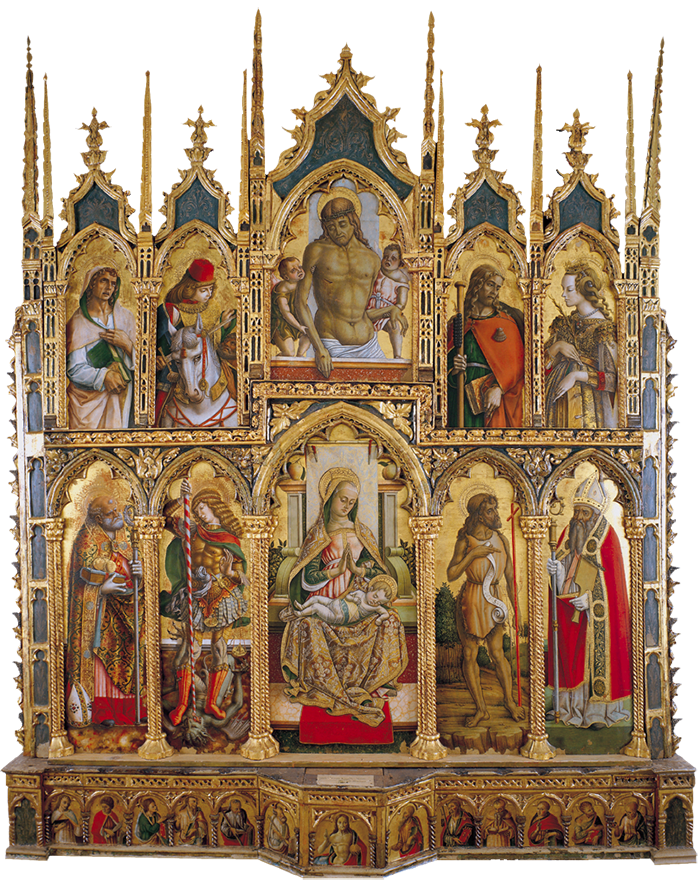
In the church of San Martino Vescovo, in Monte San Martino, there is a polyptych created by Carlo and Vittore Crivelli. Today, the building is used as a city museum, where two other polyptychs by Vittore Crivelli and the altarpiece by Girolamo di Giovanni da Camerino, dated 1473, are also located.
It is a wonderful work created by the two Venetian brothers, accompanied by an anonymous painter who created the entire predella, based on a design by Carlo.
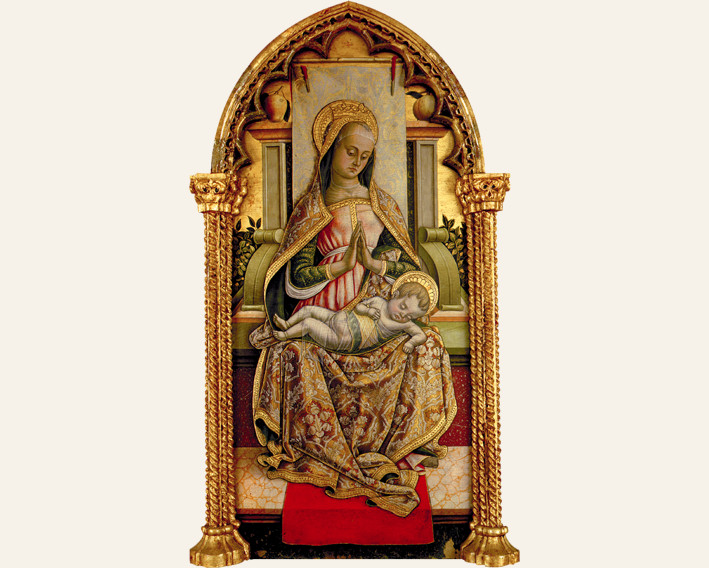
The polyptych still has its original frame, which was created by the woodcarver Giovanni di Stefano da Montelparo, who can be recognized in certain details such as: “the continuous string course frame decorated with small flattened acanthus leaves, the composite twisted columns of the lower order, the leafy capitals, the pilasters with blind tracery that serve as imposts for the pinnacles, and the usual elongated broken arch terminations, decorated on the sides with foliage” (Delpriori, 2011).
Many ideas have been put forward regarding the dating and the work of the pair: in 2006, Chiappini Di Sorio hypothesized that Vittore finished the painting to honor his dead brother, but Francesca Coltrinari recalls in her 2011 essay how the two brothers had two parallel lives. Alessandro Delpriori states that the part created by Carlo may date back to the early 1480s, while Vittore's part seems much later, close to the two polyptychs also created for Monte San Martino. Therefore, it can be concluded that the commission was requested from Carlo in the early 1480s and subsequently completed by Vittore in the early 1490s.
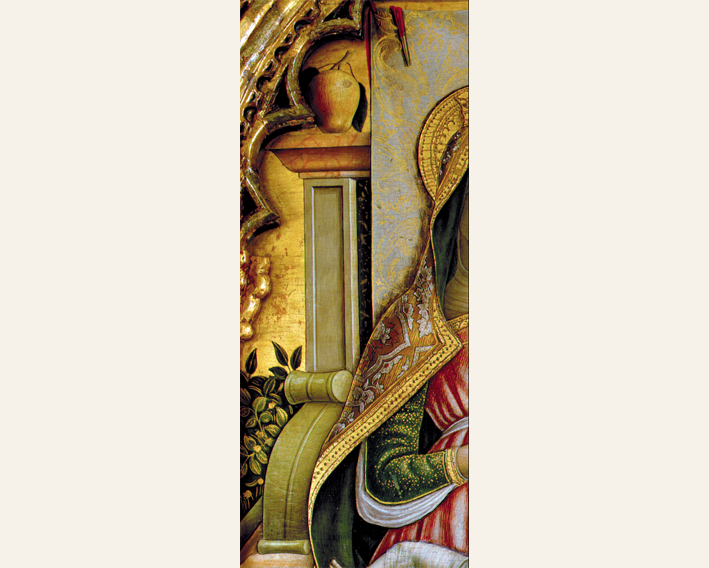
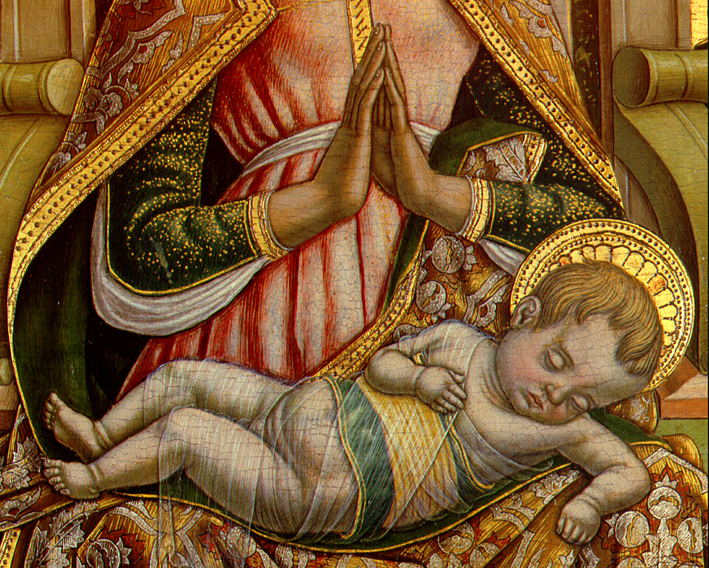
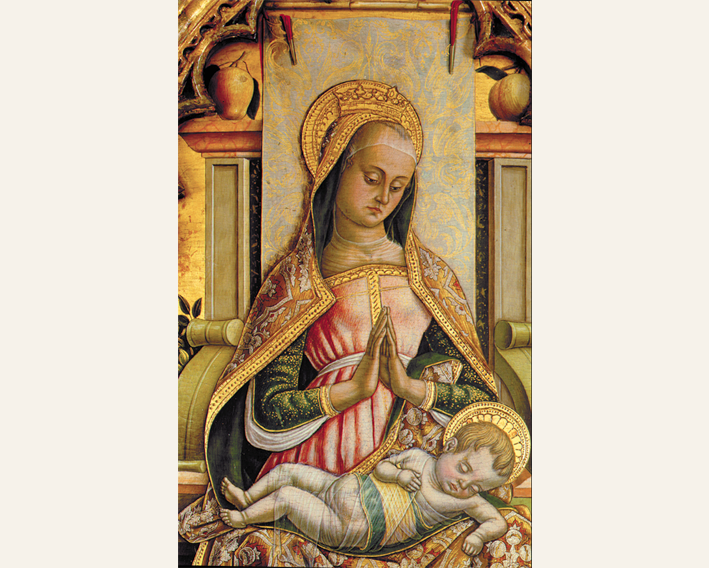
The altarpiece consists of a larger panel with a seated Madonna on a throne in the center, her hands clasped in prayer and her gaze turned toward the Baby Jesus.
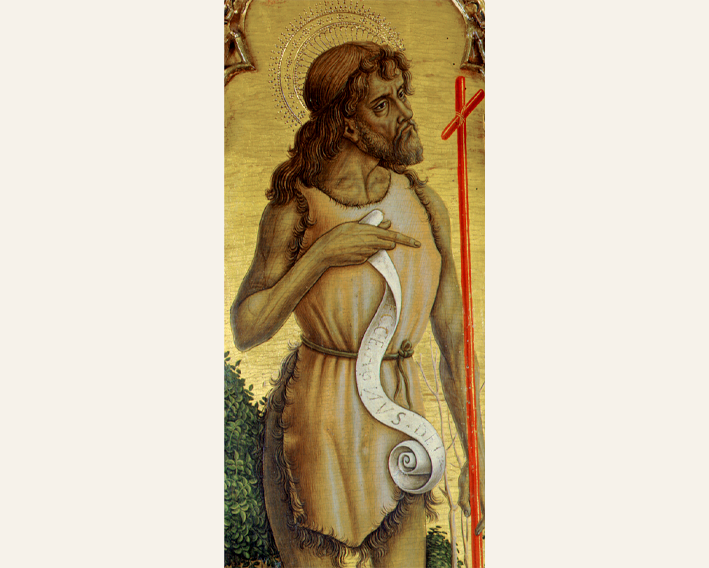
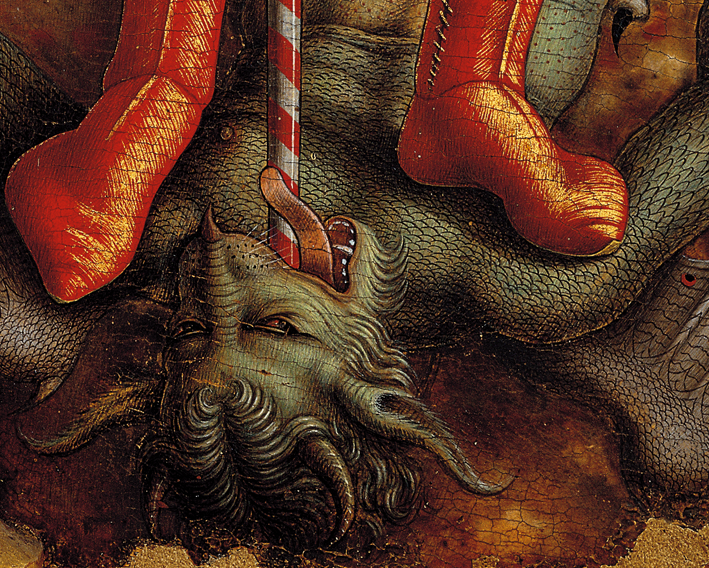
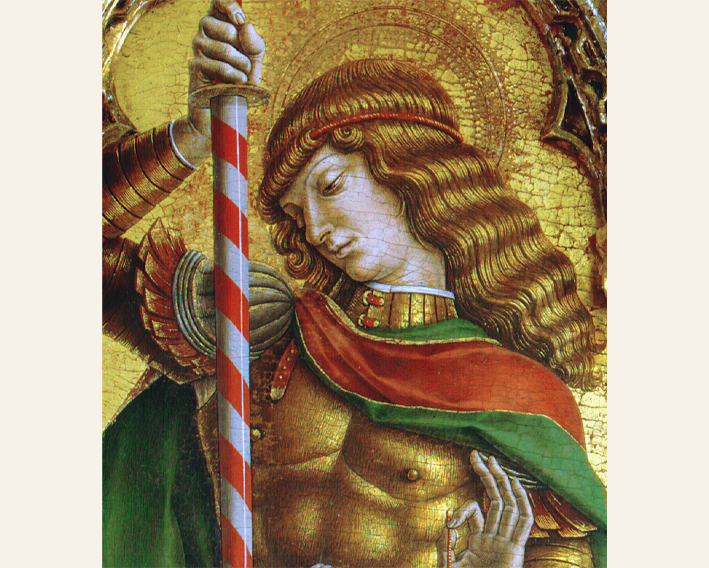
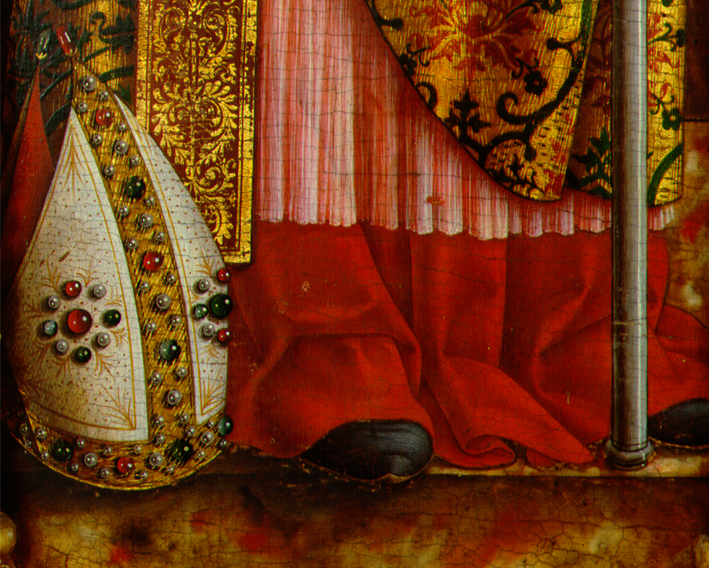
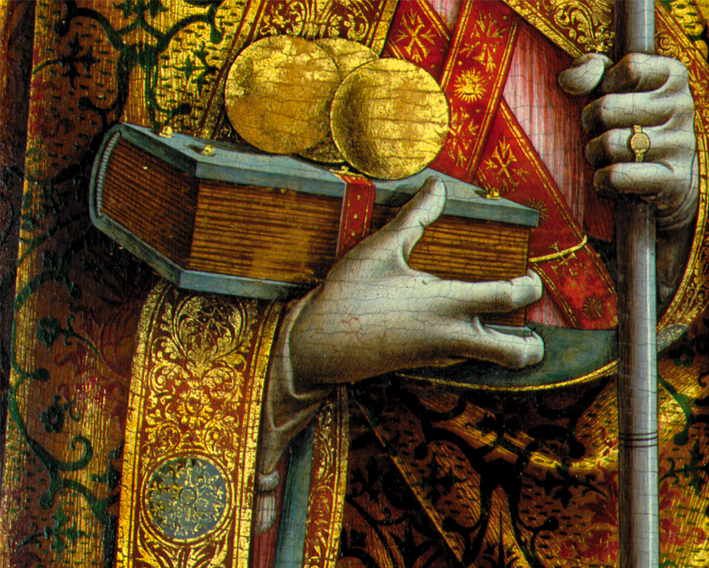
In the side compartments, we find four saints depicted with their attributes: Saint Nicholas of Bari dressed as a bishop and holding three golden spheres; Saint Michael the Archangel depicted crushing the devil; Saint John the Baptist represented in his pilgrim's clothes and holding a scroll on which is written “ECCE AGNUS DEI”; and finally St. Blaise holding an iron comb, symbol of his martyrdom.
The polyptych consists of an upper register where the figures are depicted in half-length portraits; in the center we find a dead Christ supported by two angels torn with grief among the saints: John the Evangelist, Martin, Roch, and Catherine of Alexandria.
St. John the Evangelist is depicted as a young boy carrying the Gospel, next to him is St. Martin on horseback wielding a sword made of silver foil, which has fallen off in places, revealing the red bolus. Next to the latter saint is a small beggar in prayer, which refers to the scene from the saint's life when he shared his cloak with the poor man.
Saint Roch is depicted wearing his usual pilgrim's clothes and carrying a shell, another attribute associated with his life. Finally, there is the beautiful Saint Catherine of Alexandria, dressed in noble attire, holding the blade of martyrdom and leaning delicately against the cogwheel.
In this work, gold is used to create the background and the rich fabrics of the characters, where in most cases the foil was applied using the guazzo gilding technique. The halos are embellished with punches of various sizes and types.
The predella, consisting of a central projecting step, is composed of twelve apostles divided by a central blessing Christ.
Carlo e Vittore Crivelli
Polittico, 1477 – 1480
Tempera e oro su tavola
Ordine inferiore
Madonna col Bambino in trono, S. Nicola, S. Michele Arcangelo, S. Giovanni Battista, S. Biagio
Ordine superiore
Cristo morto sorretto da angeli, S. Giovanni Evangelista, S. Martino, S. Rocco, S. Caterina d’Alessandria
Predella
Cristo fra gli Apostoli
Dimensioni
Pannello centrale inferiore: 111×50 cm
Pannelli laterali inferiori: ciascuno 100×30 cm
Pannello centrale superiore: 71×47 cm
Pannelli laterali superiori: ciascuno 65×26 cm
Predella: 20×227 cm
Chiesa di San Martino Vescovo
Via Armindo Ricci
Monte San Martino (MC)
Polyptych, Monte San Martino
In the church of San Martino Vescovo, in Monte San Martino, there is a polyptych created by Carlo and Vittore Crivelli. Today, the building is used as a city museum, where two other polyptychs by Vittore Crivelli and the altarpiece by Girolamo di Giovanni da Camerino, dated 1473, are also located.
It is a wonderful work created by the two Venetian brothers, accompanied by an anonymous painter who created the entire predella, based on a design by Carlo.
The polyptych still has its original frame, which was created by the woodcarver Giovanni di Stefano da Montelparo, who can be recognized in certain details such as: “the continuous string course frame decorated with small flattened acanthus leaves, the composite twisted columns of the lower order, the leafy capitals, the pilasters with blind tracery that serve as imposts for the pinnacles, and the usual elongated broken arch terminations, decorated on the sides with foliage” (Delpriori, 2011).
Many ideas have been put forward regarding the dating and the work of the pair: in 2006, Chiappini Di Sorio hypothesized that Vittore finished the painting to honor his dead brother, but Francesca Coltrinari recalls in her 2011 essay how the two brothers had two parallel lives. Alessandro Delpriori states that the part created by Carlo may date back to the early 1480s, while Vittore's part seems much later, close to the two polyptychs also created for Monte San Martino. Therefore, it can be concluded that the commission was requested from Carlo in the early 1480s and subsequently completed by Vittore in the early 1490s.
The altarpiece consists of a larger panel with a seated Madonna on a throne in the center, her hands clasped in prayer and her gaze turned toward the Baby Jesus.
In the side compartments, we find four saints depicted with their attributes: Saint Nicholas of Bari dressed as a bishop and holding three golden spheres; Saint Michael the Archangel depicted crushing the devil; Saint John the Baptist represented in his pilgrim's clothes and holding a scroll on which is written “ECCE AGNUS DEI”; and finally St. Blaise holding an iron comb, symbol of his martyrdom.
The polyptych consists of an upper register where the figures are depicted in half-length portraits; in the center we find a dead Christ supported by two angels torn with grief among the saints: John the Evangelist, Martin, Roch, and Catherine of Alexandria.
St. John the Evangelist is depicted as a young boy carrying the Gospel, next to him is St. Martin on horseback wielding a sword made of silver foil, which has fallen off in places, revealing the red bolus. Next to the latter saint is a small beggar in prayer, which refers to the scene from the saint's life when he shared his cloak with the poor man.
Saint Roch is depicted wearing his usual pilgrim's clothes and carrying a shell, another attribute associated with his life. Finally, there is the beautiful Saint Catherine of Alexandria, dressed in noble attire, holding the blade of martyrdom and leaning delicately against the cogwheel.
In this work, gold is used to create the background and the rich fabrics of the characters, where in most cases the foil was applied using the guazzo gilding technique. The halos are embellished with punches of various sizes and types.
The predella, consisting of a central projecting step, is composed of twelve apostles divided by a central blessing Christ.