Madonna Adoring the Child, Massignano
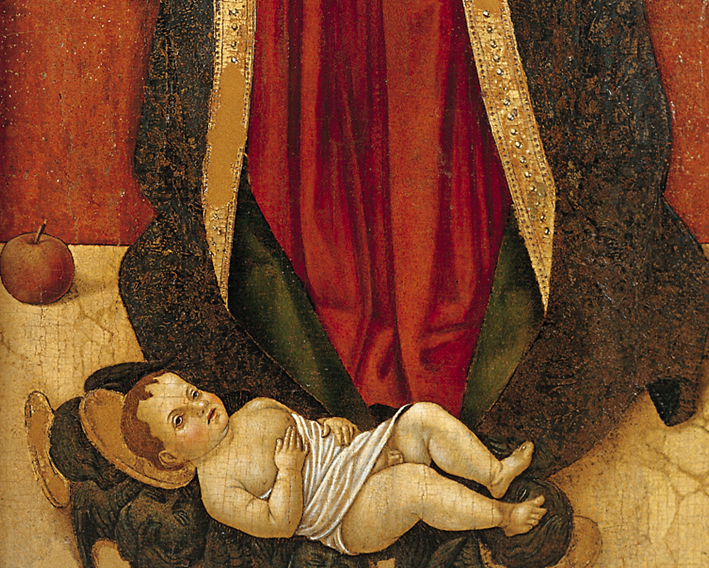
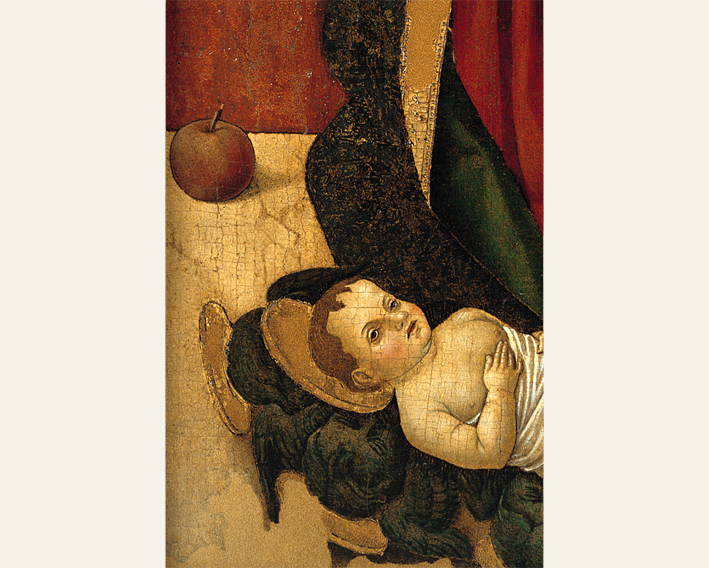
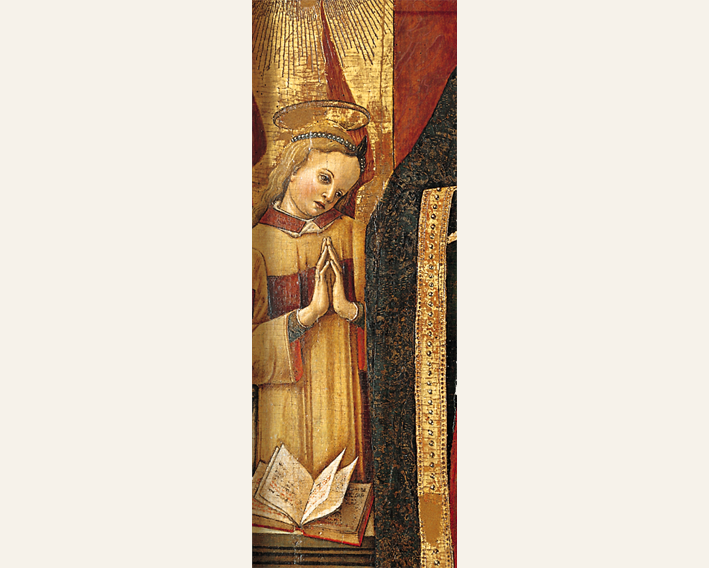
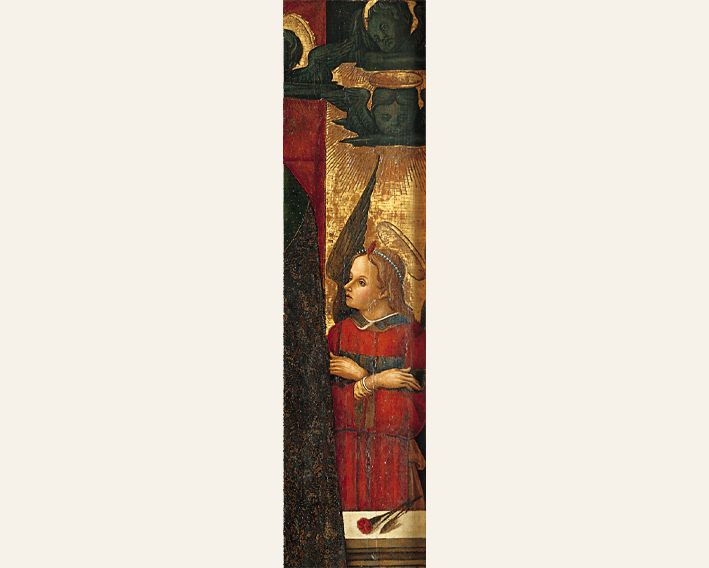
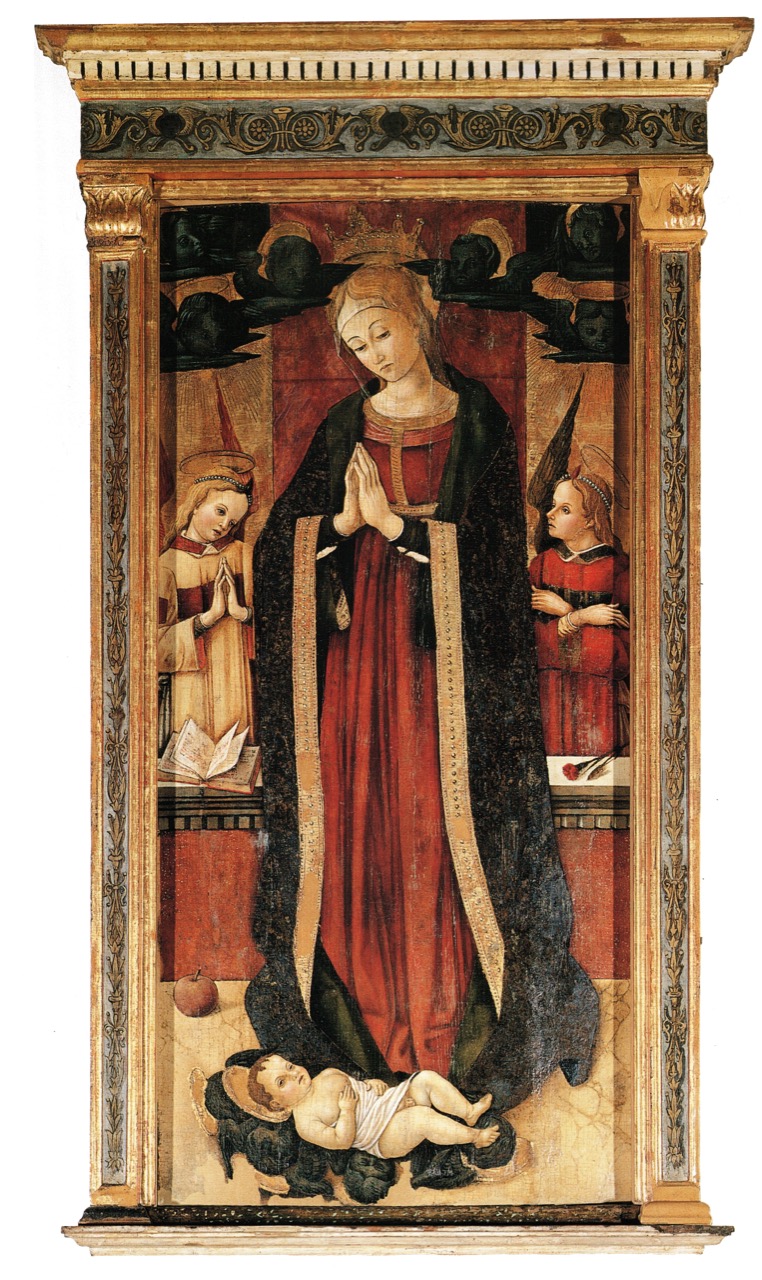
The church of San Giacomo Maggiore in Massignano houses a Madonna Adoring the Child by Vittore Crivelli. In the center of the painting, the Madonna is depicted with her hands clasped in prayer, gazing at the Baby Jesus, who is lying on a bed of cherubs. The figures are placed on a marble floor, and behind them is a windowsill on which two objects are resting: a red carnation, a symbol referring to the Virgin, and on the other side, a book with pages blowing in the wind.
Behind the low wall are two angels with outstretched wings facing the Virgin, who is being crowned by two cherubs. The background is entirely gilded, using the gouache technique, and engraved with numerous rays emanating from the blue cherubs towering above the figures.
The same iconography, which can be defined as an early attempt at the Immaculate Conception, can be found in similar panels in Falerone and Sarnano, as well as in the center of the San Basso Triptych in Cupramarittima.
The panel was exhibited at the Macerata exhibition in 1905 and was in poor condition, leading to it being described as “in the style of Vittore Crivelli, but not by him.” The work was only attributed to the Venetian artist after its restoration for the Ancona exhibition in 1950.
Vittore Crivelli
Madonna adorante con il Bambino
Tempera su tavola, 145×65 cm
Chiesa di San Giacomo Maggiore
Piazza Garibaldi
Massignano (AP)
Madonna Adoring the Child, Massignano
The church of San Giacomo Maggiore in Massignano houses a Madonna Adoring the Child by Vittore Crivelli. In the center of the painting, the Madonna is depicted with her hands clasped in prayer, gazing at the Baby Jesus, who is lying on a bed of cherubs. The figures are placed on a marble floor, and behind them is a windowsill on which two objects are resting: a red carnation, a symbol referring to the Virgin, and on the other side, a book with pages blowing in the wind.
Behind the low wall are two angels with outstretched wings facing the Virgin, who is being crowned by two cherubs. The background is entirely gilded, using the gouache technique, and engraved with numerous rays emanating from the blue cherubs towering above the figures.
The same iconography, which can be defined as an early attempt at the Immaculate Conception, can be found in similar panels in Falerone and Sarnano, as well as in the center of the San Basso Triptych in Cupramarittima.
The panel was exhibited at the Macerata exhibition in 1905 and was in poor condition, leading to it being described as “in the style of Vittore Crivelli, but not by him.” The work was only attributed to the Venetian artist after its restoration for the Ancona exhibition in 1950.